
Finding Residents Across Monroe
Begin with the most precise fact available. An address belongs first in the Ouachita Parish assessment search and Monroe map tools. A person's name works better when paired with a year, parish, street, court, or type of license. Historical questions belong in dated directories, newspapers, census schedules, and archive catalogs. Every source has a narrow job. The assessor reports assessment facts, while a recorded deed establishes a land transaction. A voter result concerns registration, and a directory shows what its publisher printed for one year.
The Monroe residents directory is therefore a source map, not a master population list. Renters may never appear on a property roll. Family members can be omitted from a deed. Protected voter addresses and sealed files do not appear in ordinary public searches. Write down the search date and the exact wording of each result before comparing it with another record family.
- Check the Ouachita Assessor by owner name or address and save the parcel reference.
- Use Louisiana's voter portal only for the limited registration and district clues it provides.
- Search the Clerk's index for deeds, mortgages, and court records tied to the name.
- For an earlier era, compare an OPL directory entry with newspapers or census material.
- Ask the record custodian for a dated, named series when an online index does not cover it.
Monroe Resident Record Keepers
Monroe is the Ouachita Parish seat, so city and parish offices answer different questions. The Clerk of Court keeps recorded instruments and court files. The Assessor connects assessed names with parcels and map context. Election records come through the Registrar of Voters and Louisiana Secretary of State. City departments hold permits, code matters, planning files, and council records. For a full address-first method, use the Monroe street directory after identifying the right jurisdiction.
Ouachita Parish Clerk of Court
301 South Grand Street, Room 104
Monroe, LA 71201
318-327-1444
Ouachita Registrar of Voters
Verify the current office address
Monroe, LA
318-327-1436
Ouachita Parish Sets the Scope
A record labeled Ouachita Parish can include Monroe, West Monroe, Richwood, Sterlington, or an unincorporated place. The official parish profile confirms Monroe as the seat and identifies the parish's separate municipalities. That distinction prevents a common error: turning a Monroe mailing line into proof that an address lies within the incorporated city.
The state profile gives the right geographic starting point for the Monroe residents directory. Follow it with a city boundary or parcel check before treating a city permit, council item, or code case as relevant. The profile shown below is a jurisdiction guide, not a list of people.
Open the official Ouachita Parish profile before choosing a custodian.
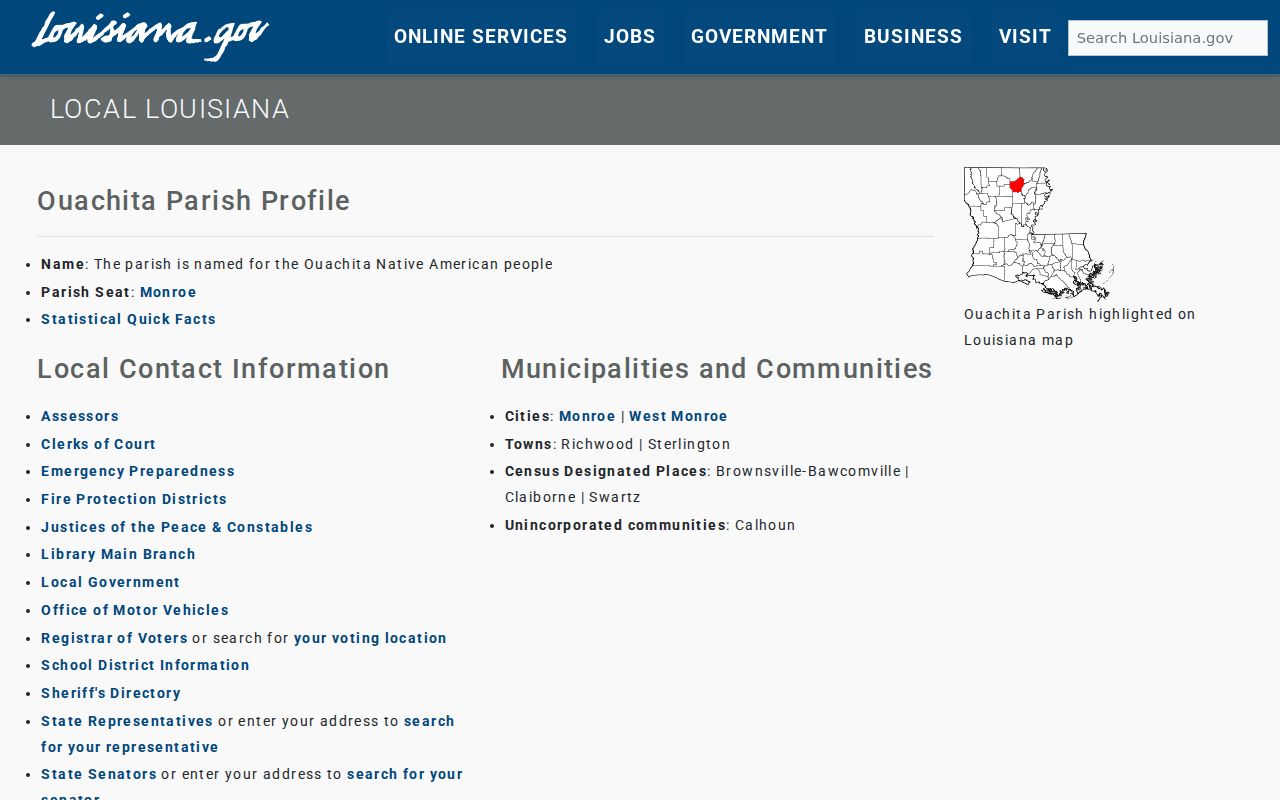
Its municipality list helps separate parishwide records from Monroe-only files.
Monroe City Records by Department
The City of Monroe gateway routes requests to legal, engineering, planning, code enforcement, utility, community, police, and council offices. A broad request for everything about a person is likely to mix unrelated records. A useful request instead names the department, record series, address or project, and a clear date range.
Review the official Monroe department gateway to find the office that created the record.
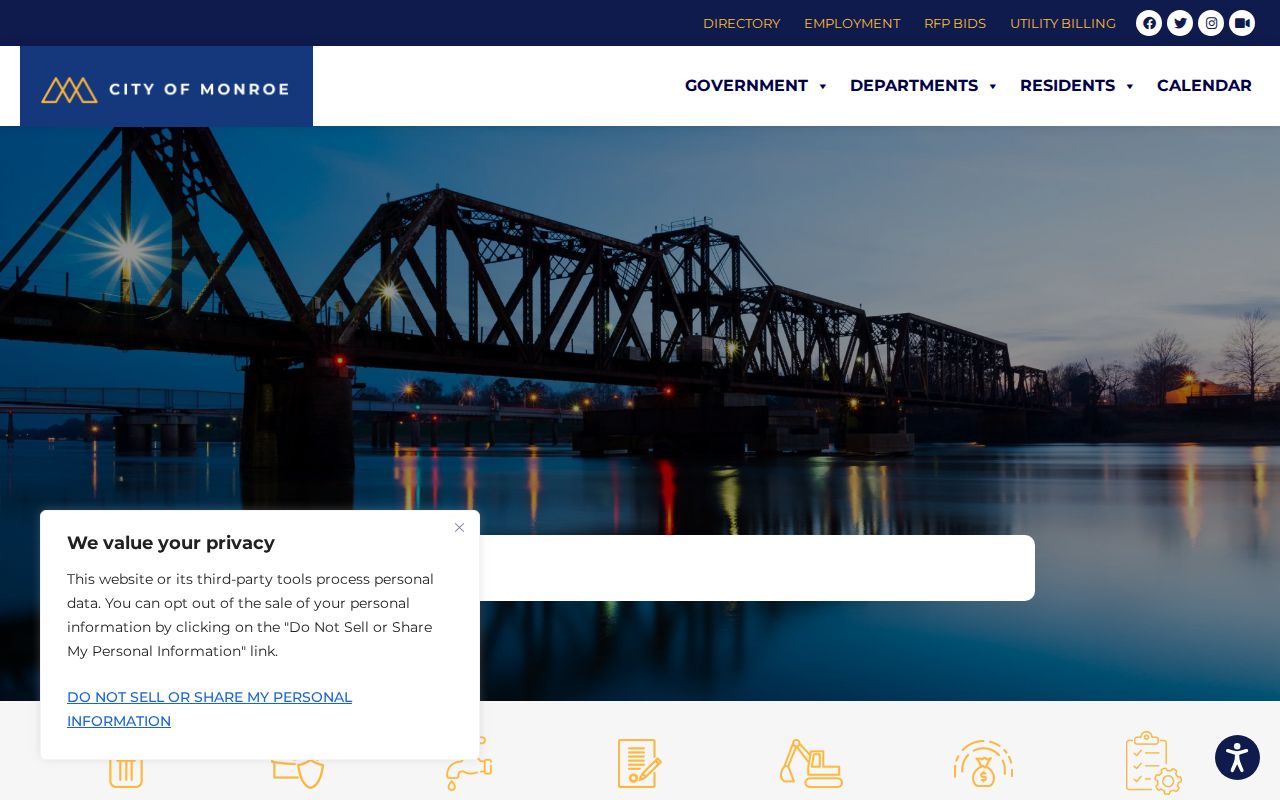
The city landing page is the correct doorway for municipal records, while parish instruments remain with the Clerk.
The city's printable request form allows inspection or copies and says no reason is required. It asks for the requested information, department, date range, and contact details. The posted schedule states a $10 startup charge and $0.25 per copy, with specialty costs varying. The online request route also accepts a message and file upload.
Inspect Monroe's public-record request form before drafting a narrow request.
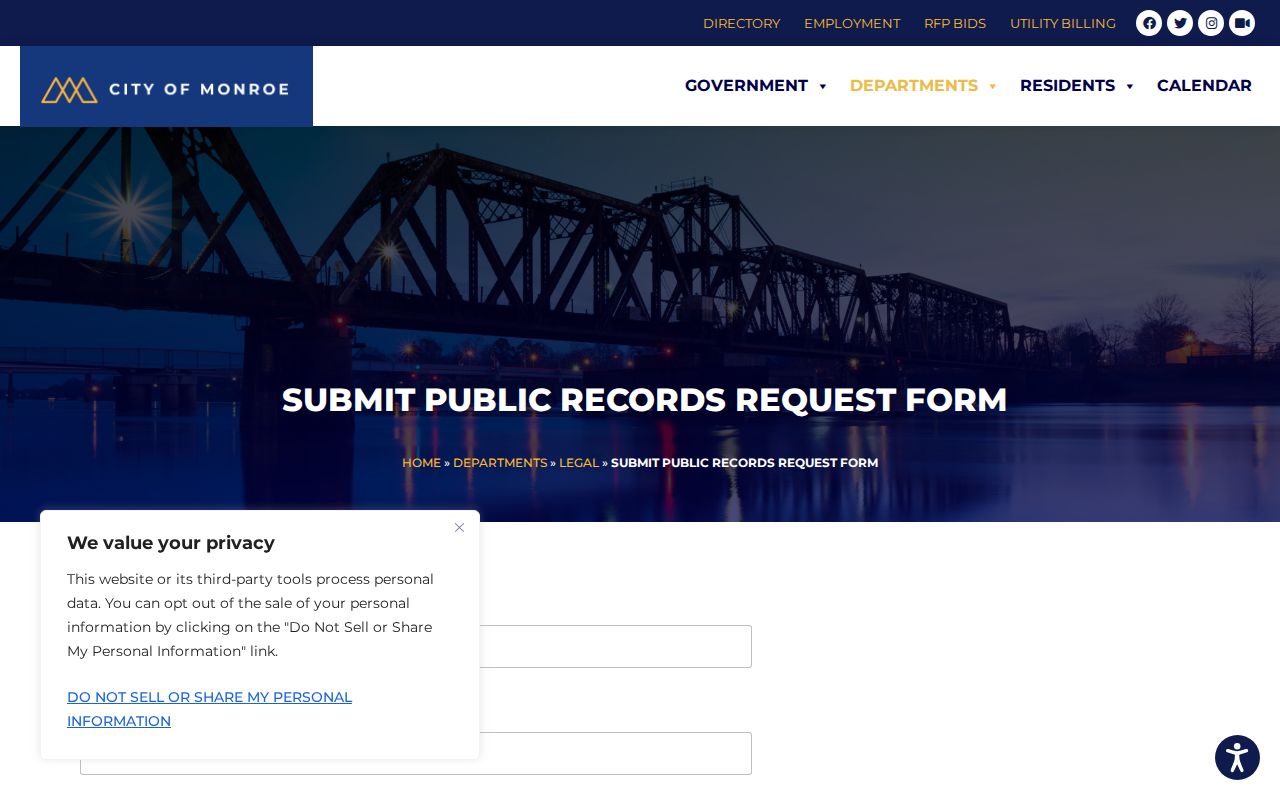
The form confirms that city-held material has a separate access path from Clerk and Assessor records.
Recorded Names at the Parish Clerk
The Ouachita Parish Clerk records conveyances, mortgages, UCC filings, marriages, election material, and parish court documents. Its office page says current records moved or merged into Clerk Connect in 2023. Posted access terms list $20 for 24 hours, $75 monthly, $800 annually, $0.50 per page, and a 3.49 percent card convenience fee with a $1 minimum. Fees and portal coverage can change, so confirm them before paying.
Read the Clerk's current-records and office information for the official route.
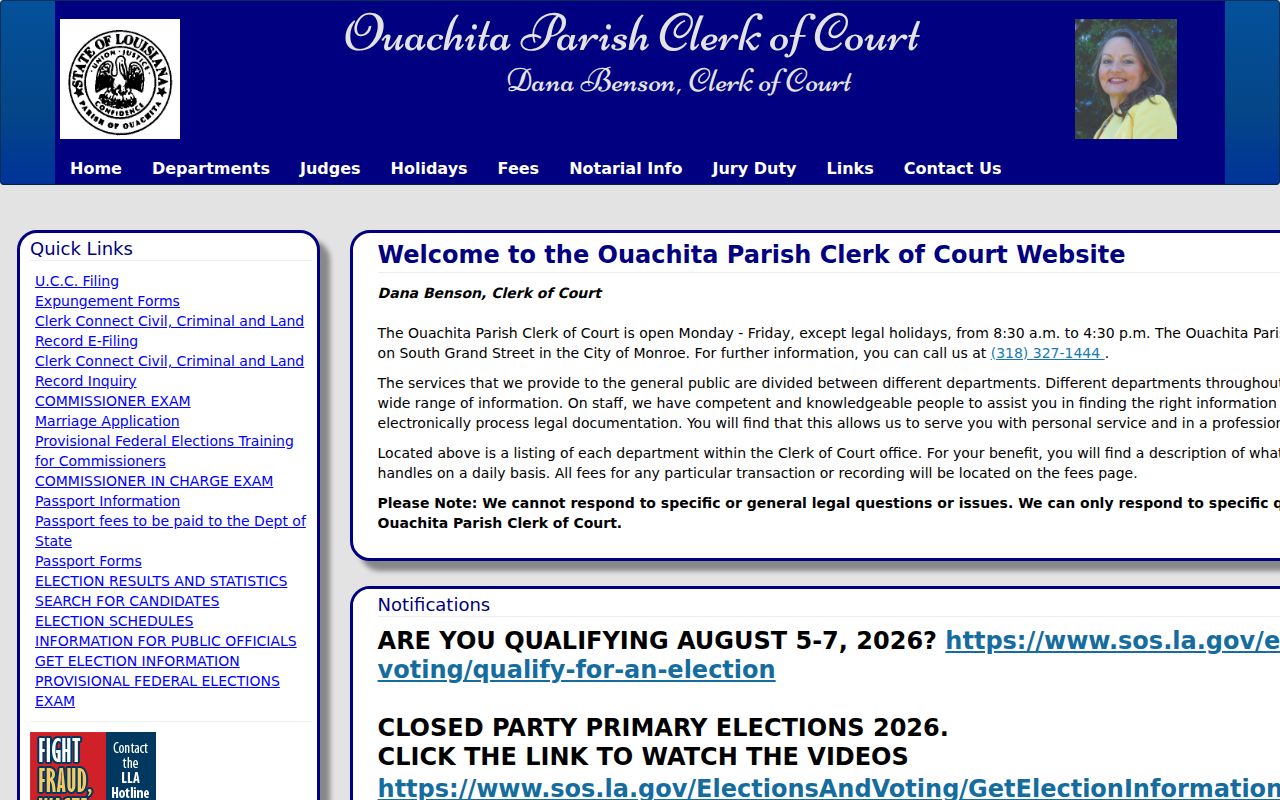
The office page distinguishes the Clerk's custody from vendor access through Clerk Connect.
- Index
- A finding list that points to a record; it is not always the document image.
- Grantor and grantee
- The parties giving and receiving an interest in a recorded instrument.
- Parcel
- A mapped unit used for assessment and land description.
- Certified copy
- A copy authenticated by the custodian for official use.
Louisiana Voter Fields in Monroe
The Louisiana Voter Portal offers name, address, and parish routes. Its name search uses first name, last name, ZIP code, and birth month and year. The address route uses ZIP, street address, apartment or lot, and city. A result can support registration, precinct, ward, or district research, but it is not a household census and does not disclose ballot choices.
| Search field | Route | How to use it |
|---|---|---|
| First and last name | Name lookup | Try exact spelling and preserve the search date |
| ZIP code | Name or address | Narrows candidates but does not prove city limits |
| Birth month/year | Name lookup | Uses month and year, not a full birth date |
| Street and unit | Address lookup | Enter apartment or lot when relevant |
| Parish | Parish route | Select Ouachita rather than assuming from a mailing city |
View the official voter name-search screen and its limited input fields.
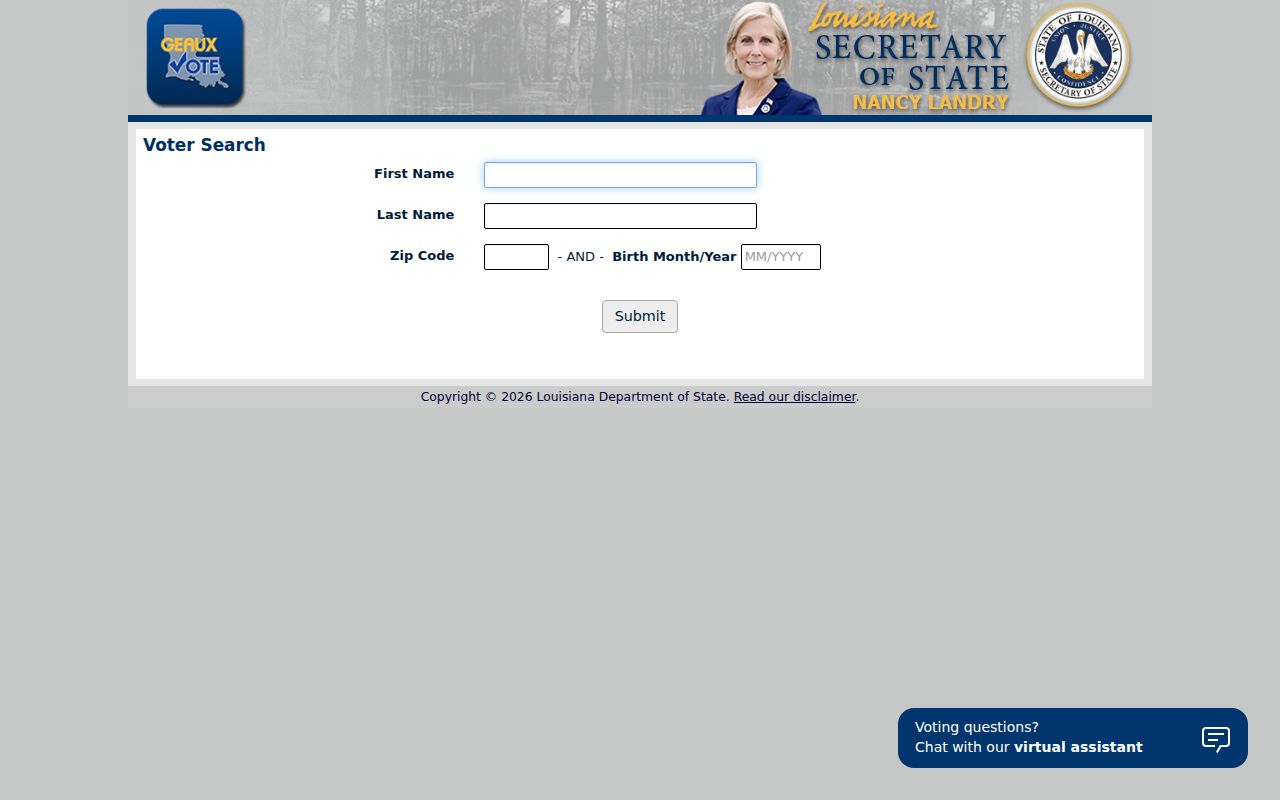
The screen illustrates why an exact ZIP and partial birth date can help distinguish same-name records without exposing a full birth date.
Use records lawfully. Louisiana protects full birth dates, Social Security and driver-license data, many email fields, and qualifying confidential addresses. Never use a lookup to stalk, harass, or harm anyone.
Current Monroe Directory Sources
Several official indexes work like limited directories because they connect a name with a recorded role, parcel, district, case, or credential. Their scope matters more than their size. A result should be described with the source's own verb: assessed, registered, recorded, filed, licensed, or listed.
| Source | Who It Lists | Keeper | Access |
|---|---|---|---|
| Assessment roll | Assessed owners and parcels | Ouachita Assessor | Free search described |
| Voter Portal | Matching registration and districts | Louisiana SOS | Limited public lookup |
| Recorded-instrument index | Parties to deeds and mortgages | Ouachita Clerk | Index and paid image routes differ |
| Council records | People named in public city business | City of Monroe | Agendas and minutes online |
| License searches | Board credential holders | Louisiana boards | Board-specific searches |
A name in one row does not carry the meaning of another. For example, a registered agent address does not establish a household, and an assessed owner may receive mail elsewhere. The Monroe resident lookup explains how to verify one person across independent record families.
Monroe Courts Need the Right Index
State, city, parish, appellate, and federal cases use different systems. The Fourth Judicial District Court serves Ouachita and Morehouse parishes, but no direct public trial-docket search was confirmed in the inspected material. Monroe City Court handles matters within its jurisdiction, while federal cases belong in PACER. Sealed, juvenile, adoption, and expunged material is not available through an ordinary public name search.
Open the Louisiana Courts Monroe City Court page to see its limited name-and-state search surface.
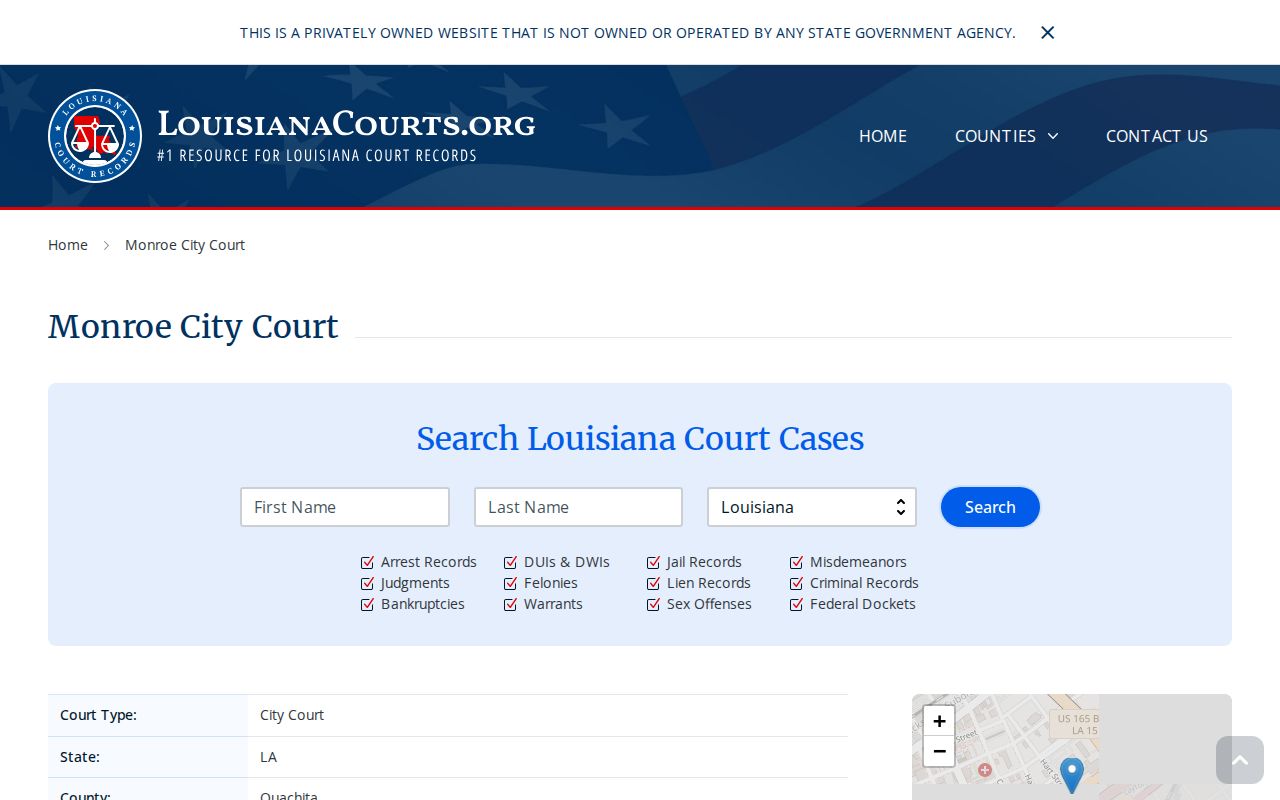
The state court page is only one jurisdictional lead, not a substitute for Fourth JDC or federal records.
The Louisiana Fourth Circuit search is appellate only. It accepts categories and case criteria that do not represent the local trial-court docket.
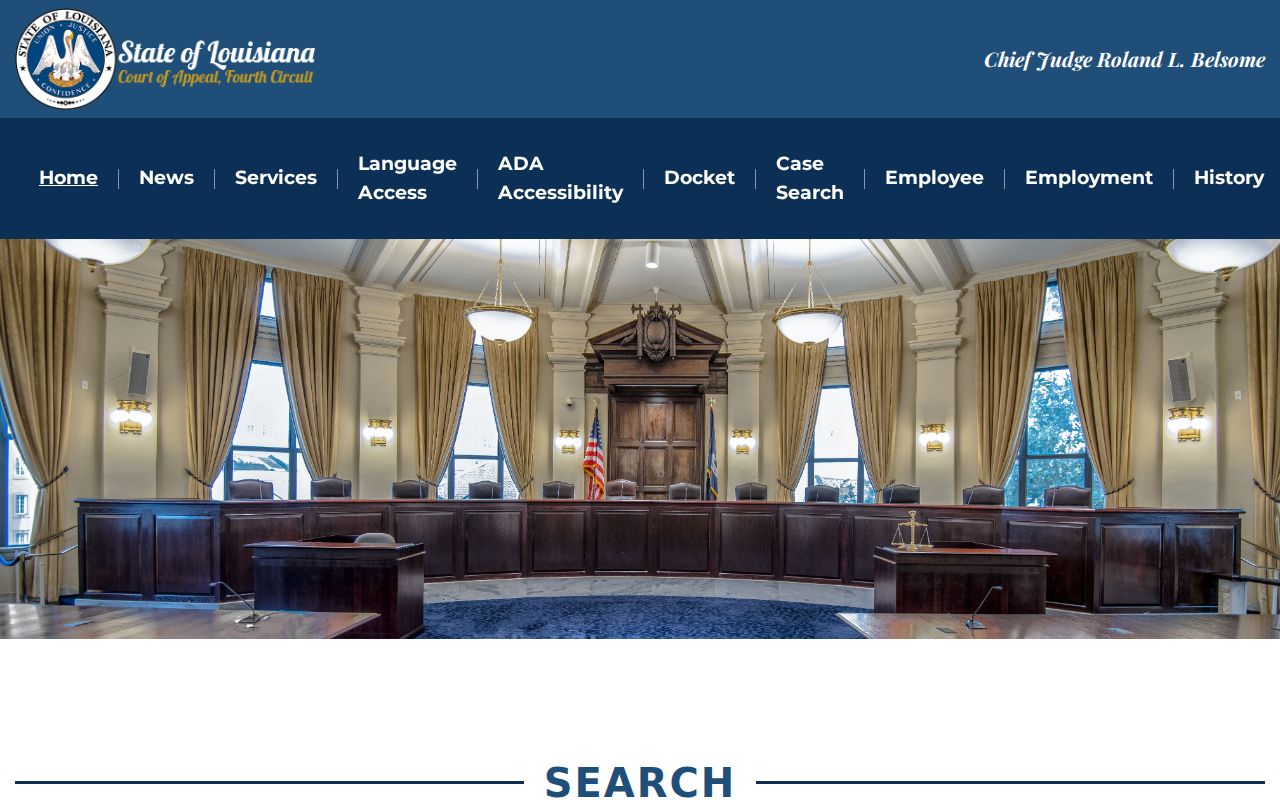
The appellate interface shows why court level and case number must be recorded with any match.
Official Rolls Versus Compiled Profiles
Official records are narrower but easier to interpret. Each has a custodian, legal purpose, date, and correction route. Commercial people-finder profiles combine fragments from many places and may be stale, incomplete, or attached to the wrong person. They are described here only as a category and are not recommended or linked.
| Feature | Official Monroe source | Compiled profile |
|---|---|---|
| Meaning | Tied to a defined public function | Blends data from unknown dates |
| Correction | Contact the Assessor, Clerk, Registrar, court, or board | Opt-out and correction terms vary |
| Evidence | Index, image, or certified copy can be cited | Source lineage may be unclear |
| Best practice | Verify with a second record family | Return to the original custodian |
Monroe Public Records Requests
Louisiana Public Records Law, La. R.S. 44:1 and 44:31–35, covers documentary material connected with public business unless an exception applies. Adults generally may inspect or copy public records, and the custodian bears the burden of showing that an exception applies. R.S. 44:32 includes a five-business-day framework for a written determination when a records question is presented, not a promise that every large production will finish in five days.
Ask for one series held by one department. Give a date range, address, parcel, docket, or project name and state whether inspection or copies will work. Keep the request, proof of delivery, response, fee estimate, cited exception, and final disposition. If the city does not hold the record, ask which office created it.
Privacy Protections for Monroe Residents
Open-record rules exist beside specific limits. Louisiana's Address Confidentiality Program, La. R.S. 44:51–57, provides a substitute-address framework for qualifying survivors who have relocated. Protected voters should also contact the Registrar. Modern birth records remain confidential for 100 years after the year of birth, and death records for 50 years after the year of death under the cited Louisiana vital-record rules.
Louisiana Act 502 was enacted with privacy provisions scheduled to take effect January 1, 2027. Until that date, describe it as future law rather than a current operating opt-out system. Official records may also remain available even when a commercial site removes a copied profile.
Historical Monroe Resident Directories
The Ouachita Parish Public Library Genealogy Room combines city directories, newspapers, microfilm, yearbooks, family histories, and Special Collections. Its published pages do not state a complete directory-year run, so confirm holdings with staff before planning a visit. ULM Special Collections adds Northeast Louisiana finding aids and image collections, while Louisiana Digital Library provides digitized documents from participating institutions.
Review OPL's family and local-history resources before searching the shelves.

The library page identifies the local tools that can confirm a directory clue with newspapers and microfilm.
A 1947–48 Monroe and West Monroe volume demonstrates why one book can support several searches: it contains alphabetical, street, business, property-owner, and telephone sections. An owner mark is an editorial convention, not proof of title. The Monroe city directory collections page explains how to read these entries and trace a household across years.
Monroe Records Across Time
The record trail changes with both government and geography. Ouachita Parish dates to 1807, Monroe incorporated in 1820, and Fourth Judicial District Court history marks courthouse milestones in 1816, Civil War damage in 1864, and a red-brick courthouse built in 1883. Those dates help place an older deed, newspaper notice, or directory entry in the right administrative setting.
Modern access also has cutover dates. The Clerk reported its current-record move in 2023. City council materials observed in research span 2014 through 2026. Assessor grand-recap reports are posted for 2016 through 2025. Preserve these coverage statements as limits, not as claims that older or newer records do not exist.
Monroe counted 47,702 people in the 2020 Census, while the 2024 Census estimate was 46,622. Both figures use city geography, not every address with a Monroe mailing line. Dates and boundaries belong beside every number in a careful residents directory.
Physical access remains important when a portal stops short. The Clerk can answer whether an older instrument is indexed, imaged, or available only through a counter request. OPL staff can confirm whether a directory year, newspaper reel, obituary index, yearbook, or house-history source is present before a researcher travels. ULM Archives can identify a finding aid or collection that the general web does not expose. State Archives indexes cover older births and deaths under their stated year limits, while modern certificates stay with the Louisiana Department of Health and remain subject to eligibility rules.
Keep a simple source log for every Monroe search. Record the office or collection, record title, search terms, access date, year covered, result identifier, fee, and any warning shown by the keeper. Mark a negative result as not indexed, outside coverage, protected, wrong jurisdiction, or blocked by an account gate when that is what happened. This leaves room for a later counter search instead of turning a portal limit into a false claim that no record exists.