
Monroe Directory Collections by Year
Monroe city directory research begins with the Joseph Bennett McGuire Genealogy Room at Ouachita Parish Public Library. The library confirms that Monroe and West Monroe directories were issued annually and that older volumes are kept in the room. It does not publish a complete shelf list online. Several years below are therefore discovery leads, not a claim that every edition is on the shelf. Ask staff to confirm the exact title, year, publisher, and format before making a special trip.
| Collection | Years | Where Held | Access |
|---|---|---|---|
| Monroe and West Monroe city directories | Annual series; leads include 1912 through 1966 with gaps | OPL Genealogy Room | Confirm each volume with staff |
| C.B. Page Directory Co. edition | 1947-48, eleventh edition | Digitized discovery scan | Read page images; OCR may be wrong |
| Reverse or criss-cross volumes | Separate run not confirmed | OPL catalog and Genealogy Room inquiry | Publisher and years remain a research gap |
| Monroe newspapers | Named runs from 1859 through 1977 | OPL microfilm and databases | Issue, page, and image check required |
| Sanborn maps | 1913, 1926, and 1932 | OPL Special Collections and Library of Congress | Map context, not an occupant list |
| ULM and Louisiana digital collections | Collection-specific dates | ULM Archives and Louisiana Digital Library | Browse finding aids or contact staff |
Discovery references identify editions for 1912, 1913, 1921, 1929, 1930, 1933-34, the 1940s, the 1950s, 1964, and 1966. No official source found in the research establishes the first Monroe edition, a full publisher sequence, or the final printed year. Treat a missing year as an open catalog question, not proof that publication stopped. The reliable statement is narrower: older annual volumes are available through the library, and the verified 1947-48 example shows how rich one edition can be.
A useful shelf request separates confirmed holdings from citations found elsewhere. National Register material may cite an edition because researchers used it, while a discovery site may point to a scan. Neither proves that OPL owns that exact volume today. Write down the citation, ask the Genealogy Room to check its catalog and shelves, and note whether the item covers Monroe alone or the combined Monroe and West Monroe area. This prevents a directory bibliography from being mistaken for a complete local inventory.
Monroe Directory Research at OPL
The Ouachita Parish Library family and local history department brings several kinds of evidence into one place. The Genealogy Room is on the first floor and holds books, magazines, newspapers, yearbooks, family histories, and a microfilm reader and printer. The India King Stubbs Special Collections/Rare Book Room is on the second floor, and an appointment is recommended. Published hours are Monday through Friday from 9 a.m. to 6 p.m., with Saturday morning and afternoon blocks.
Call 318-327-1490 before a long visit and ask whether the needed directory year is in print, on microfilm, or available through a database. Special Collections can also be reached at genealogy_SC@oplib.org. A precise request works best: give the city, approximate year, person or street, and whether a scan or citation is needed. The library's database list points to Ancestry Library Edition, Louisiana Digital Library, Chronicling America, and the Newspapers.com Southeast Collection. A database hit is a lead. Save the original image and source details.
Note: Confirm a directory year and room access with library staff before travel, because the complete local shelf run is not posted online.
Monroe Directories Meet Civic Records
A historical address gains context when dated municipal records are added. The Monroe City Council page identifies the city government and points to public meeting material. It can help establish when a street project, public facility, or municipal action entered the record. The image below preserves the council access point as it appeared during research.
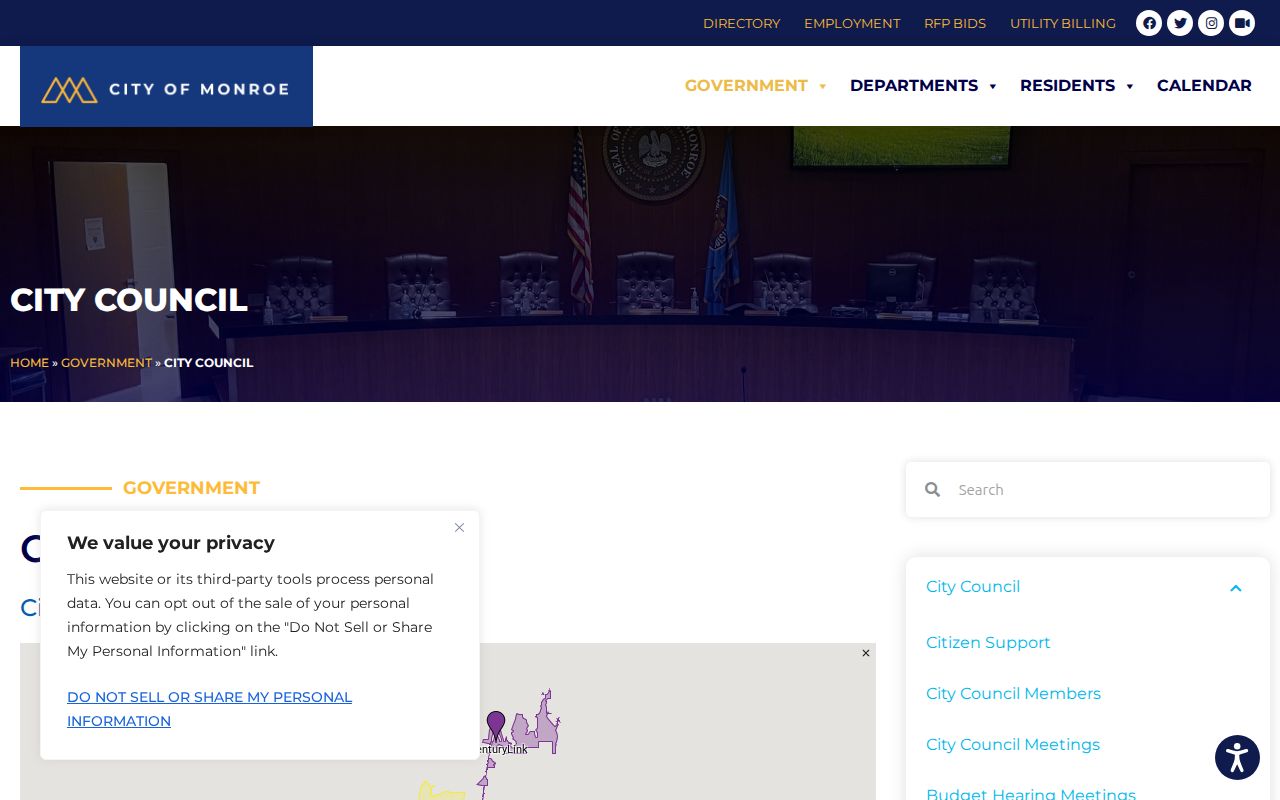
The council page is not a resident roll. Use it to date civic events around an address, then return to the city directory edition for the listed name.
The separate council meetings archive posts agendas and minutes across a 2014-2026 run. Those documents can explain a later project tied to a historic block. The captured meetings page shows the route into that dated paper trail.
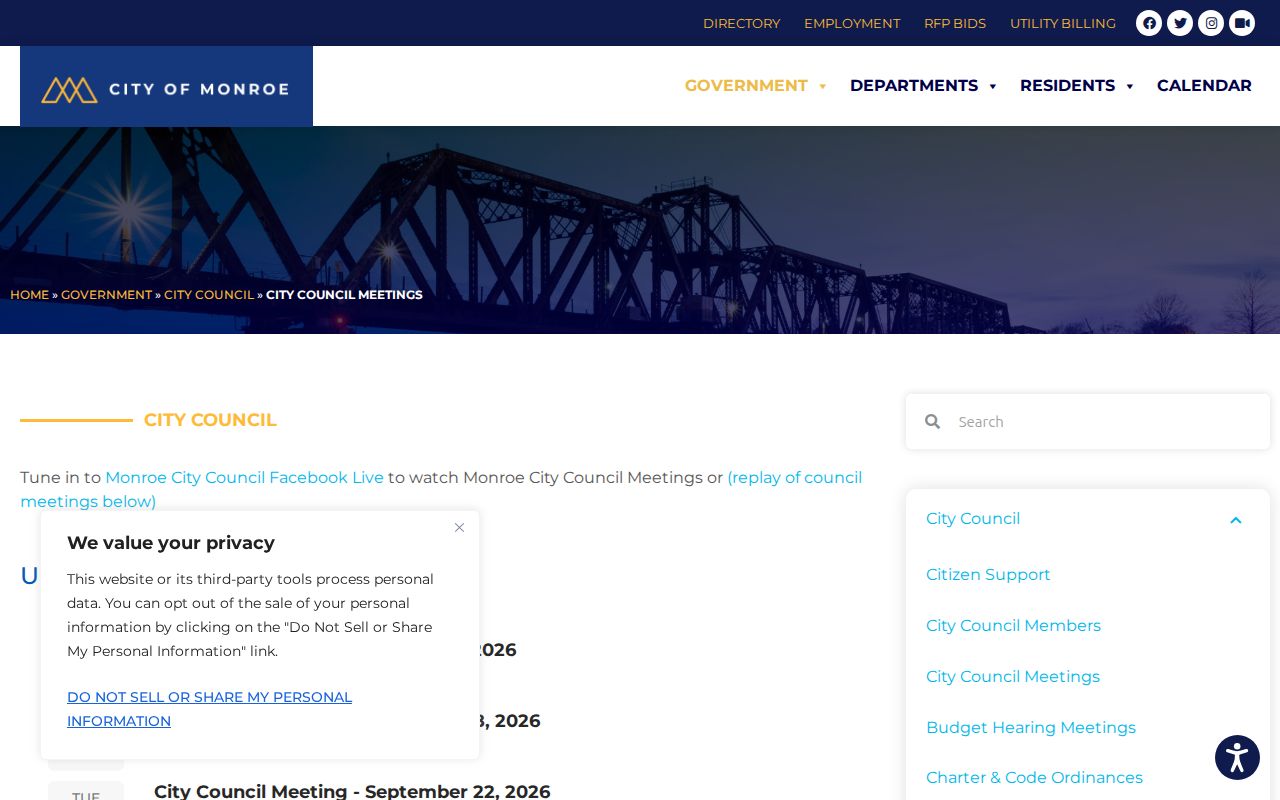
Record the meeting date, agenda item, and final minutes separately. An agenda shows that an item was scheduled; adopted minutes show what the public body recorded.
Read a Monroe Directory Entry
The 1947-48 Monroe and West Monroe city directory is an eleventh edition published by C.B. Page Directory Co. Its alphabetical, street, business, property, and telephone sections let one fact be checked from several angles. Read the scanned page, not just extracted text, because the discovery page warns that automated OCR may contain errors. Photograph or save the abbreviation key before interpreting marks.
| Name | Spelling as printed, sometimes with a wife name in parentheses |
|---|---|
| Household clue | A child count may appear, but the volume does not promise every person |
| Address | Street number and name for that edition's publication period |
| Business clue | Occupation, role, or classified business listing where supplied |
| Owner mark | An editorial property-owner convention that must be checked against a deed |
| Telephone clue | A number can be cross-checked in the numerical telephone section |
- Criss-cross directory
- A directory arranged by street or address instead of only by surname. A separate Monroe run has not been confirmed.
- Householder index
- The street-order portion that links a numbered address to the listed person or business in that edition.
- Abbreviation key
- The volume's own legend for shortened terms and symbols. It controls how marks should be read.
Monroe Directory Addresses and Planning
Planning records can explain why an old directory address now sits in a historic district, a changed land-use area, or a redesigned parcel pattern. The Monroe planning and zoning page provides current municipal context and meeting routes. Its research capture appears below.

A current zoning label does not tell who occupied a site decades ago. Pair it with the dated directory, a Sanborn sheet, and any meeting document that explains the change.
The city also routes building activity through its inspections and permitting page. Permits may add a work date or project description after the directory era. The captured page documents that access channel.

Permit evidence belongs in its own dated column. It should not be read backward as proof that the person in an older directory owned the parcel.
Monroe Directories Beyond the Shelf
The Louisiana Digital Library offers scanned photographs, papers, and partner collections. One Monroe lead is the OPL Americanus Willis and business-document collection. A directory name or business can be searched there, but the collection is not a complete index of residents. Capture the item title, creator, date, collection, and image URL. That turns a name match into a traceable archival citation.
ULM Special Collections and Archives adds Northeast Louisiana historic images, local-history holdings, military collections, theses, and finding aids such as Otto Passman and James Noe materials. Institutional name changes matter: ULM opened in 1931 under an earlier name and adopted its current name in 1999. Search older catalog records under the name used at the time. An archivist may know of folders that are not indexed online.
The Americanus Willis collection is a useful lesson in method. A business clue in a city directory may lead to a scanned letter, advertisement, or photograph. Each item describes one moment, not an entire life. Keep the directory date beside the item date, and do not merge people with similar names without another source.
FamilySearch can serve as a discovery catalog for Ouachita and Louisiana materials, but access varies by item and affiliate location. Search the place hierarchy as well as the title. For naturalization, military, church, funeral-home, and delayed-birth material, the research found no complete Monroe index. OPL vertical files, ULM finding aids, Louisiana State Archives, NARA, churches, cemeteries, and funeral homes are possible next custodians. Ask about a named collection and year instead of assuming that every record type was preserved together.
Map Monroe Directory Addresses
Sanborn fire-insurance maps place a listed address in a building footprint. OPL identifies Monroe sheets for 1913, 1926, and 1932, including print maps in Special Collections and a route to the Library of Congress collection. A sheet may show materials, outbuildings, nearby businesses, and street numbers. It cannot name every person inside. Match map and directory years as closely as possible.
Newspapers add dated events. OPL names runs for the Daily Telegraph, Monroe Morning World, Monroe News-Star, Register, Weekly News-Star, and other regional titles. Chronicling America confirms several historic Monroe titles. Search a street, business, and surname, then cite the paper title, issue date, page, and whether the item was news, a notice, or an advertisement.
Monroe and West Monroe face each other across the Ouachita River. A shared directory title does not erase their municipal boundaries. Preserve the city label printed in the source and use a dated map when a historical address seems to cross the river.
The 1950 Census adds another checkpoint. Its Ouachita search is organized by wards and enumeration districts, with descriptions that may cite institutions and streets. Those old boundaries do not map cleanly to a current ZIP or precinct. Read the enumeration-district description with the schedule image, then cite the ward, district, sheet, and line. A directory fills years between federal censuses, while the census can test household details that a publisher shortened or omitted.
Trace Family Through Monroe Directories
A year-by-year Monroe city directory trail works best as a sequence of dated observations. It can show a spelling, address, business role, telephone, spouse notation, or owner mark as the publisher printed it. It cannot by itself explain why a listing changed. Census schedules, newspapers, deeds, obituaries, and maps test the possible reasons.
- Start with one confirmed name, spelling, and approximate Monroe year.
- Check the alphabetical section, then the street and telephone sections in the same edition.
- Move one available edition at a time and log address, spelling, and household changes without guessing.
- Pair directory years with the nearest census. Cite a census person by year, parish, ward or enumeration district, sheet, and line.
- Test an ownership mark against the Ouachita Parish deed record, and test a disappearance with newspapers or the obituary index.
A person missing from the next volume may have moved, died, changed names, been omitted, or simply gone unlisted. The library's obituary search is a discovery route, with a local-history post describing an index from 1825 to 1991, but the current scope must be verified. View the newspaper image before relying on a relationship or address. For a current, address-keyed method, use the Monroe street directory instead of extending a historical listing into the present.
Ownership mark. The 1947-48 symbol is a publisher's convention, not a recorded instrument. Confirm ownership with the Ouachita Parish Clerk of Court.