
Monroe Previous Resident Sources
A backward address trail needs sources that cover different eras and different facts. The Ouachita Parish Public Library’s house-history workflow is the local starting point. It combines assessment, deeds, permits, directories, newspapers, maps, and archive material rather than treating one index as complete.
| Source | Years it covers | Where held | What it shows |
|---|---|---|---|
| Recorded deeds | Pre-1970 in person; post-1970 online route described | Ouachita Clerk, Clerk Connect | Parties, instruments, legal description |
| City directories | Annual volumes; exact complete run unpublished | OPL Genealogy Room and selected scans | Dated names, addresses, phone and business clues |
| 1947-48 directory | One verified C.B. Page edition | Digitized discovery scan | Alphabetical, street, property and phone sections |
| Sanborn maps | 1913, 1926, 1932 Monroe sheets | OPL Special Collections and LOC | Building footprint and street context |
| 1950 Census | 1950 public schedules | National Archives search | Households by ward and enumeration district |
| Newspapers | Named Monroe runs from the nineteenth and twentieth centuries | OPL, databases, Chronicling America | Dated events, notices, obituaries, ads |
| ULM Archives | Collection-specific | ULM Special Collections | Finding aids, local images and regional papers |
Choose the source nearest the period being studied. A recent chain begins with a parcel and deed. An older household may surface first in a directory, map, census district, or newspaper. Always label the year and record type.
Trace Monroe Resident Ownership
The Assessor provides the present parcel lead, while the Ouachita Parish Clerk of Court keeps the recorded title instruments. The library guide places pre-1970 ownership research at 301 South Grand Street, Suite 104, and describes post-1970 ownership as online for a fee. The exact complete online cutoff and image coverage were not confirmed, so an absent portal result is not proof that no deed exists.
- Find the current parcel, assessment year, situs, and visible legal description through the Assessor.
- Locate the newest purchase instrument through Clerk Connect or eClerks and read the image or request a copy.
- Identify the seller, then search that person or entity as a prior grantee to locate the earlier acquisition.
- Repeat the transfer chain while recording instrument number, date, book and page, parties, and legal description.
- When online access stops, continue with the Clerk’s in-person books, index, or requested copies.
A chain can include successions, trustees, corporations, partial interests, corrections, sheriff sales, or reserved rights. The legal description and image matter more than a familiar street number.
- Grantor
- The party transferring a recorded interest.
- Grantee
- The party receiving that interest.
- Chain of title
- The sequence of recorded transfers for the same land interest.
- Legal description
- The lot, block, subdivision, metes-and-bounds, or other land wording that identifies property beyond its street line.
Monroe Directories Mark a Year
The verified 1947-48 Monroe and West Monroe directory is especially useful because one person or address can appear in more than one section. The C.B. Page Directory Co. edition includes an alphabetical list, a numerical street or householder section, classified businesses, a property-owner guide, and a numerical telephone section. A wife’s name may appear in parentheses, and a child count may appear. Those are publishing conventions, not complete household proof.
Begin with the street section, copy the address and listed name exactly, then test the name in the alphabetical pages. Compare the telephone and property marks only when visible. The discovery page warns that OCR can contain automated errors, so the scanned image controls any quotation.
Open the 1947-48 Monroe directory discovery page before reviewing the captured source.
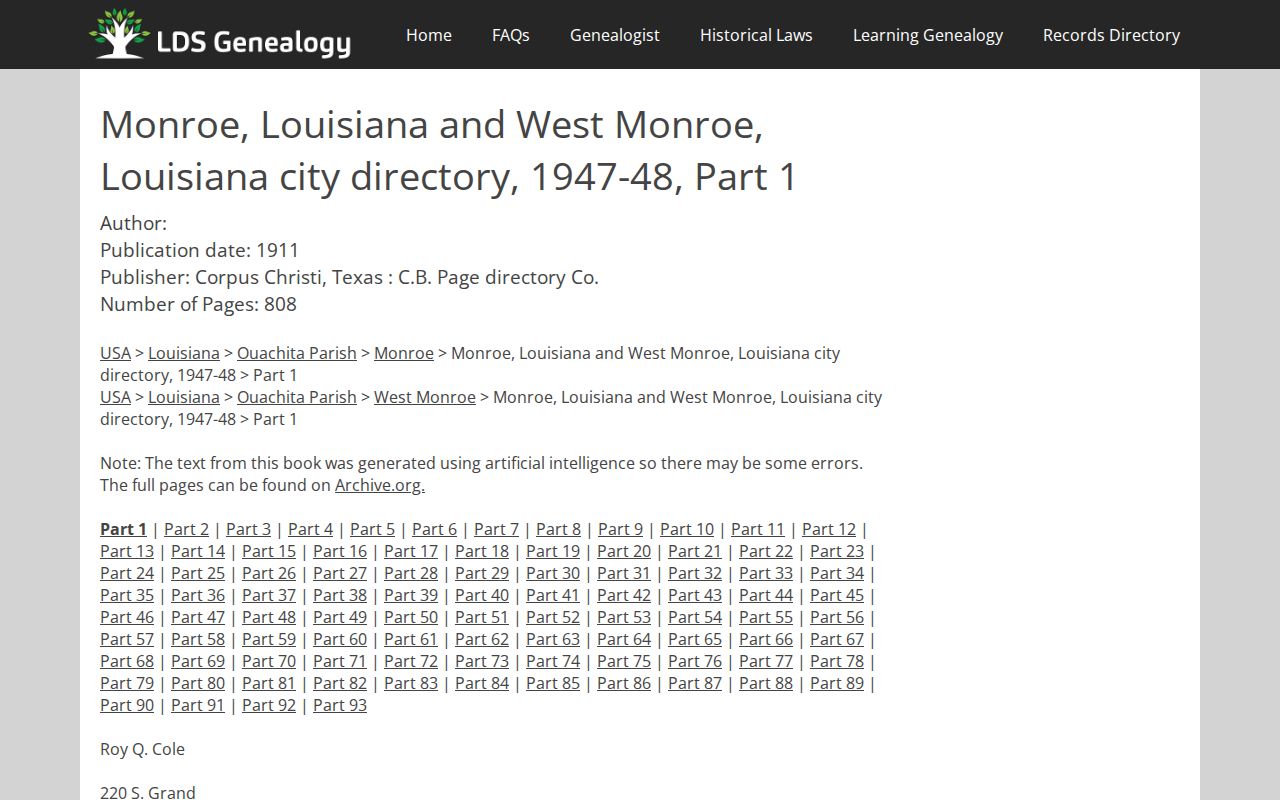
The image shows the assigned digitized directory route, which can place past residents at an address during one edition but cannot establish current occupancy or title.
Separate reverse or criss-cross directory coverage was not confirmed in an official online shelf list. Ask the Genealogy Room for the exact publisher, year, and access rule before citing such a volume. The fuller shelf context belongs on the Monroe city directories page.
OPL Builds Monroe Resident Histories
The Ouachita Parish Public Library family and local history service places the Joseph Bennett McGuire Genealogy Room on the first floor. Its resources include books, newspapers, yearbooks, family histories, and a microfilm reader and printer. The India King Stubbs Special Collections and Rare Book Room is upstairs, with an appointment recommended.
Library databases add Ancestry Library Edition, Louisiana Digital Library, Chronicling America, and a regional newspaper collection. Treat an index hit as a pointer. Save the title, issue date, page, image, and source collection before adding a person or event to the address timeline.
The library’s house-history guide is an insider advantage because it separates pre-1970 and post-1970 ownership access. It also names the permits, maps, directories, newspapers, and historic-register sources that can explain a building even when no resident name is found.
Map Former Monroe Residents
Sanborn fire-insurance maps can place a historical address into a dated footprint. OPL identifies Monroe sheets for 1913, 1926, and 1932, with print material in Special Collections and a route to the Library of Congress Sanborn collection. A sheet may show materials, outbuildings, nearby businesses, street numbers, and fire context. It does not name every resident.
Compare a Sanborn year with the nearest directory edition and any permit or newspaper date. If the street number differs, test lot and block, neighboring structures, intersections, and the recorded legal description. Research did not locate an official Monroe street-renumbering history, so a changed number must remain an evidence question, not a claimed citywide event.
Monroe and West Monroe sit across the Ouachita River within the same parish. A combined historical directory may use both city names, while current municipal and postal records follow different boundaries. Keep the city label from each source.
Pair Monroe Directories and Census
Owners tell only part of the story. A directory may list a householder in a certain edition, and a census schedule may show a household at the next public census point. The 1950 Ouachita search is organized through wards and enumeration districts, with descriptions that mention streets, institutions, hotels, and other boundaries. Those historical areas do not translate directly into current ZIP codes or precincts.
- Copy the directory address, name spelling, edition year, section, and page.
- Find the relevant census ward or enumeration-district description for that period.
- Search or browse the schedule, then cite state, parish, ward or district, sheet, and line.
- Compare each named relationship and address with the original image, not an index alone.
- Mark gaps as “not located” rather than carrying a household forward into another year.
A directory listing means listed at the address. A census image means enumerated there on that schedule. Neither proves uninterrupted residence between dates.
Monroe Resident Newspaper Clues
Newspapers can turn a flat address listing into a dated event. OPL holdings include Daily Telegraph, Monroe Morning World, Monroe News-Star, Register, Weekly News-Star, and other Northeast Louisiana titles. Chronicling America also identifies Monroe title runs including Register, Ouachita Telegraph, and Daily Telegraph. Search the street, number, business, and spelling variants together.
A building notice, advertisement, social item, obituary, sale notice, or meeting report should be recorded with newspaper title, issue date, page, and item type. An advertisement is not an editorial finding. A legal notice may describe a proposed or procedural action rather than its final result.
The OPL-linked obituary index is described by a local-history project as reaching 1825 through 1991, but the current library page does not independently confirm that full span. Use it as a discovery lead and check the newspaper image before relying on family ties or an address.
ULM Previous Resident Archives
ULM Special Collections and Archives adds Northeast Louisiana historic images, local history, theses, military-history material, and finding aids connected with collections such as Otto Passman and James Noe. These holdings are not a complete resident index. Their value lies in collection context and items that may never appear in a general web search.
Review the ULM Archives collection gateway before viewing the assigned capture.
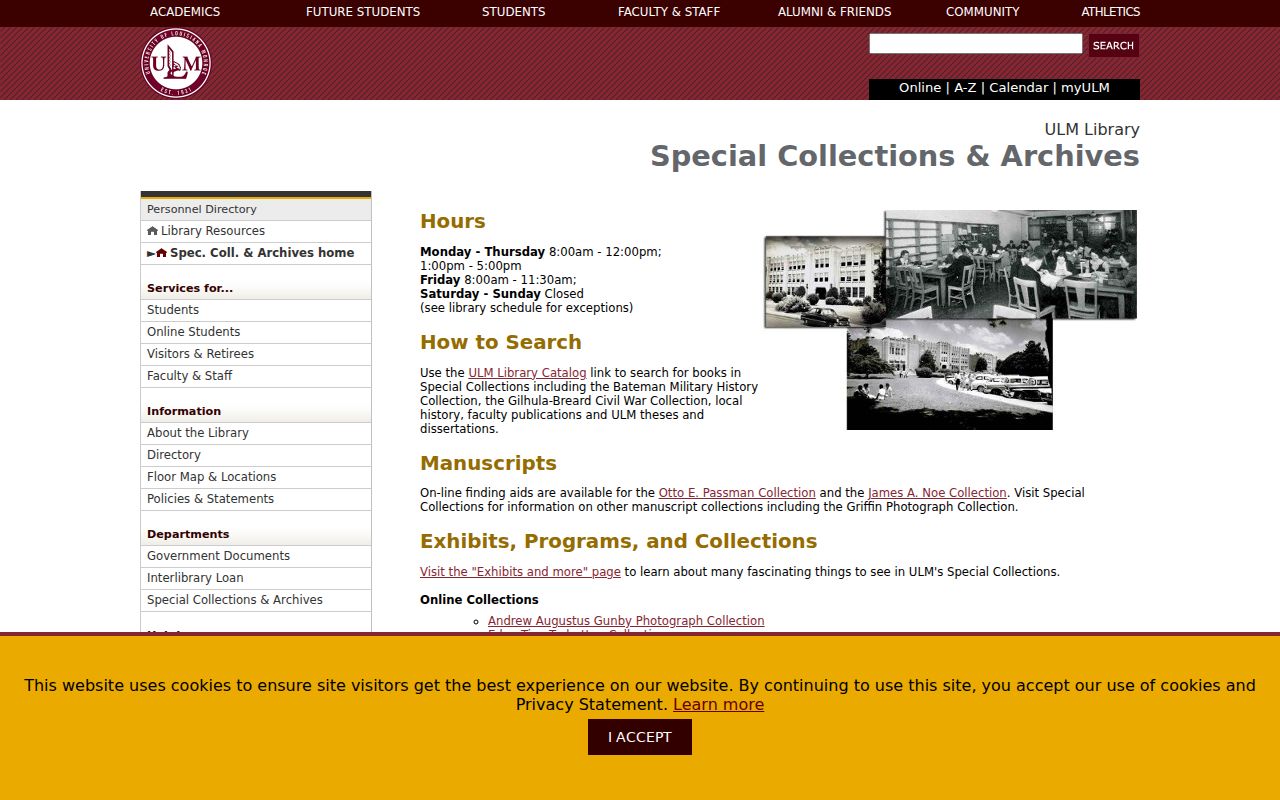
The captured archive page points past residents research toward finding aids and staff help when a family, institution, photograph, or address is not fully indexed online.
A useful archive inquiry gives one name, an address, a date range, and the known source. Ask whether an unindexed collection, vertical file, photograph, or restriction applies. This keeps the request narrow and reproducible.
Label Monroe Resident Evidence
A former-resident timeline should distinguish four claims: listed at an address, named in a recorded instrument, mentioned in a dated item, and inferred from several sources. The 1947-48 property-owner mark is a good example. It is a directory convention worth testing against a deed, not a substitute for recorded title.
Keep contradictions. A deed mailing line, directory street number, census district, map sheet, and newspaper notice may disagree because of time, postal use, transcription, city label, or indexing. The disagreement often reveals the next search step.
Evidence boundary. A directory marks one edition, an assessment marks a tax context, and a deed records an instrument affecting land.
Note: Cite the original image, page, sheet, instrument, or finding aid whenever a Monroe index supplies only a brief lead.
Responsible Monroe Resident Research
Previous residents research suits family history, estate work, local history, and careful curiosity about a building. It should not expose a living person’s private routine, protected location, personal phone, or inferred household. Public records also change and can contain errors.
No record should be stretched beyond its purpose. A permit applicant is not necessarily an occupant. An assessed name is not always a title holder. A directory omits people. A census captures one official enumeration. A map describes a footprint, not a family.
Lawful use. Trace past residents and Monroe house history responsibly. Never use an address trail to stalk, harass, intimidate, or harm a living person.