
Walk a Monroe Street Record
A useful street search moves from the broad address to the most stable property identifiers. The Ouachita Parish Assessor describes its real-estate search as free and says it accepts criteria such as owner name and address. Its linked DataScout map is the fastest place to identify an assessment parcel. An assessment name is a lead, not proof of title or present occupancy.
Record the exact address entered, the assessment year, and the parcel or account number shown. Street suffixes, city labels, and postal forms can differ across sources. A parcel number and legal description usually survive those changes better than a typed mailing line.
- Search the address in the Assessor or DataScout system and save the parcel identifier.
- Place the parcel on the Monroe city map and note the street, jurisdiction, and nearby lots.
- Use the parcel and assessed name to locate the latest deed in the Clerk’s recorded-instrument route.
- Check the Louisiana voter address route only for the limited registration clue it lawfully returns.
- For an earlier household, compare the address with a dated street section at the parish library.
This street-by-street order keeps an attractive name match from becoming a false claim about who lives there now. It also leaves a clear trail another researcher can repeat.
Monroe Street Directory Parcels
The direct Ouachita DataScout property portal is the practical first screen. The official description confirms name and address searching plus interactive mapping. The research did not expose every live field, sort control, or parcel-card field, so do not assume a mailing-address field or export option that is not visible.
| Search control | Confirmed use | Safe reading |
|---|---|---|
| Owner name | Officially described | Assessment lead tied to a tax year |
| Property address | Officially described | Routes a street number to a parcel |
| Interactive map | Select and view property | Geographic parcel context |
| Parcel details | Save visible account data | Check labels before quoting |
The Assessor warns that assessment information is not a legal guarantee and does not determine ownership or flood status. A homestead entry reflects a tax application, not a full list of occupants.
Open the official parcel search before viewing the captured interface.
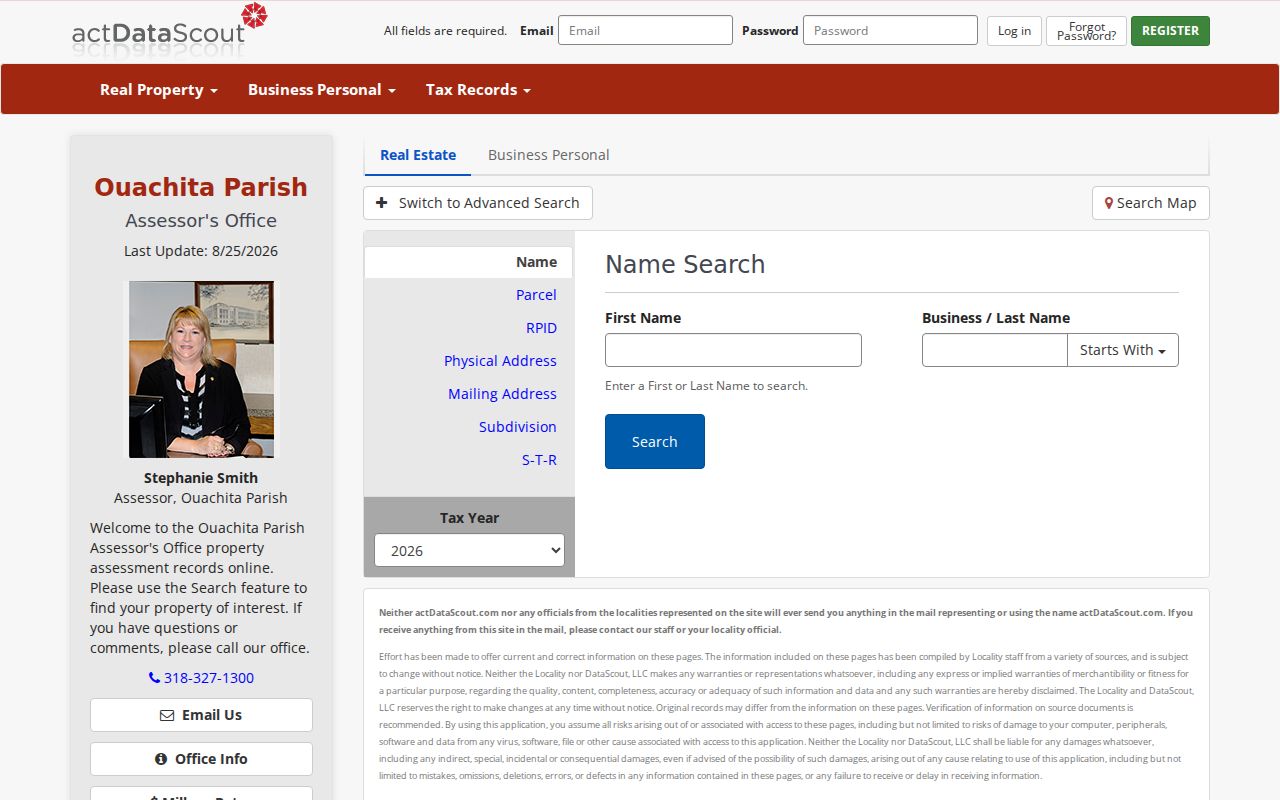
The image anchors the address workflow to the Ouachita portal assigned to Monroe, while its displayed labels control the search.
Records Along Monroe Streets
No source lists every person at every address. Address records overlap, and their gaps matter. This coverage table separates the keeper, result, and access channel.
| Address source | Keeper | What it shows | Access |
|---|---|---|---|
| Assessment parcel | Ouachita Assessor | Name, parcel, situs, tax context | Free DataScout search |
| City map | Monroe Engineering | Street and visible city layers | ArcGIS viewer |
| Recorded instrument | Ouachita Clerk | Parties, date, type, legal description | Clerk Connect, eClerks, copies |
| Permit or inspection | City MGO or parish office | Project, applicant, work and status | Portal or office request |
| Voter route | Louisiana SOS | Limited registration or district clue | Regulated lookup |
| Dated directory | Ouachita Parish Library | Year-specific name, phone, street section | Genealogy Room and scans |
| Postal result | USPS | Mailing form, city and ZIP clue | Address lookup |
These records were made for title, tax, city, historical, election, or postal work. They do not combine into a current household census.
Map Monroe Streets Carefully
The Monroe Interactive City Map can place an address within the municipal workflow. Search or pan to the street, select the relevant visible feature, and retain the layer name and map date. Research did not confirm the live parcel popup fields, buffer tool, or full layer list. Those features should not be promised.
Adjacent lots, cross streets, zoning or historic layers, and municipal features can distinguish two similar addresses. They cannot prove friendship, family ties, shared households, or occupancy. Monroe and West Monroe face each other across the Ouachita River, so a familiar parish or mailing label does not erase the city line.
- Parcel
- A mapped unit of land used for assessment and record matching.
- Situs address
- The physical property address, which may differ from an owner’s mailing address.
- Plat
- A recorded map showing lots, blocks, streets, or subdivision boundaries.
- Criss-cross directory
- An address-first or phone-first directory for finding a listed name in one edition.
Note: Save the street spelling exactly as each Monroe source displays it before deciding that two entries match.
Verify Monroe Street Ownership
The key comparison is assessment versus title. The Assessor gives a free map and tax lead. The Ouachita Parish Clerk of Court keeps conveyance and mortgage instruments. A dated directory supplies historical context. None can stand in for another.
Current records moved or merged to Clerk Connect in 2023. eClerks LA describes a free index with separate parish or image access. A complete instrument may require an account, paid image, or Clerk copy. Capture the instrument number, book and page or electronic reference, recording date, document type, grantor, grantee, legal description, and image status. A grantor transfers an interest; a grantee receives it.
When a street number looks uncertain, compare lot, block, subdivision, parcel reference, nearby lots, and map position. A deed may convey only part of an interest, reserve rights, correct an earlier filing, or involve an estate. Read the instrument image before calling it a simple sale.
Monroe Addresses Before 1970
The Ouachita Parish Public Library house-history guide gives a local shortcut. It directs pre-1970 ownership research to an in-person Clerk stop and says post-1970 ownership is online for a fee. That is an access guide, not proof that every later deed image appears online.
The workflow adds the assessment parcel, permits, annual Monroe and West Monroe directories, newspapers, and Sanborn maps. It helps when the current street line fails to retrieve an older entry. Keep the historic spelling, directory year, map sheet, and legal description beside each other.
Read the library’s house-history steps before viewing the assigned capture.
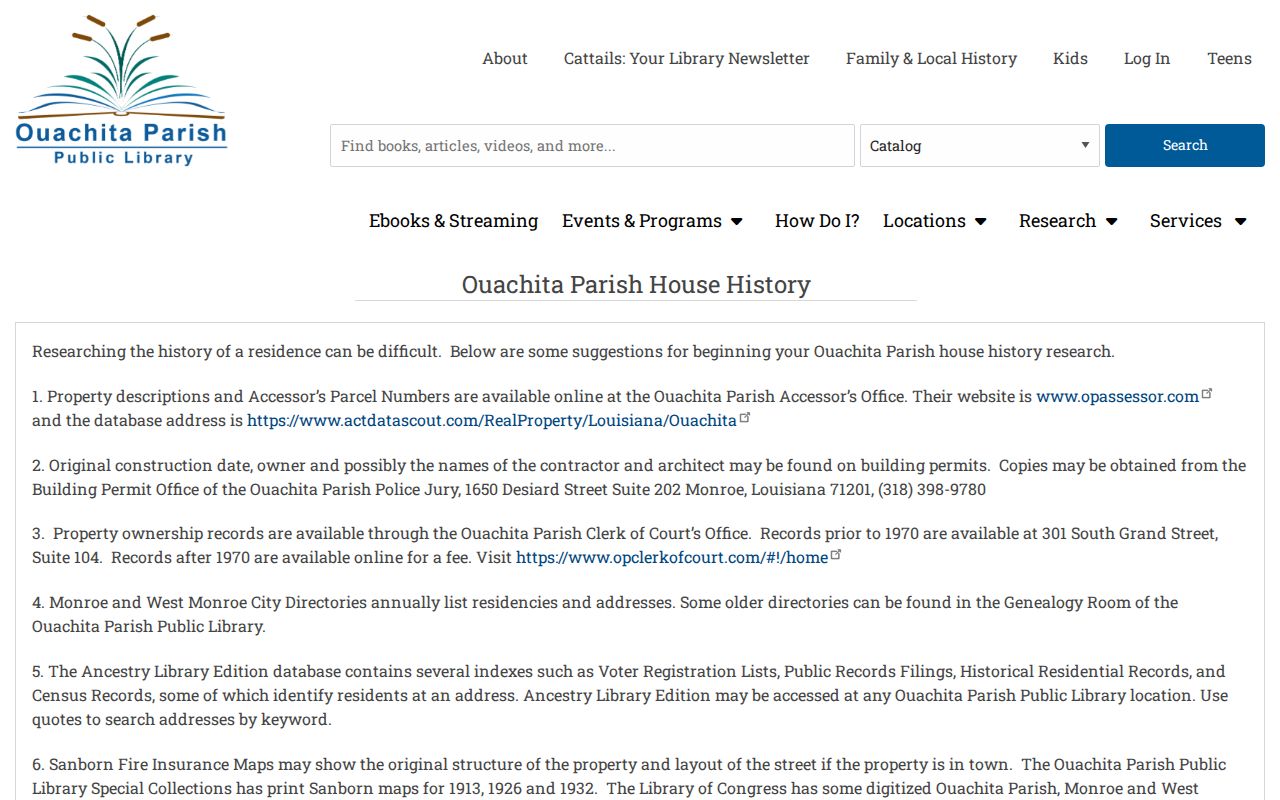
The capture shows why the library is a full access channel when an online street directory reaches its limit.
Monroe Street Permit Chronology
The city’s Inspections and Permitting office links to MGO for applications, payments, inspections, project status, files, notices, registrations, and GIS integration. Public search fields were not exposed without the account workflow. Describe only fields actually visible in a result.
Permit records can date construction, demolition, excavation, roofing, or other work. The project form asks for an application date or permit number, applicant details, property-owner details, project street and nearest cross streets, and a work category. A named applicant may be an owner, company, agent, or contractor, not a resident.
Code enforcement follows a separate address route and may show complaints, inspections, photos, notices, summonses, or hearings. A complaint is not a finding. Use procedural facts without turning a case into a judgment about a person.
Monroe Street and ZIP Clues
The USPS address lookup can normalize a street line and recognized mailing city. It does not confirm a person or firm at that address. Monroe city limits, postal routes, Census areas, and Ouachita Parish boundaries can overlap without matching.
Louisiana’s voter portal offers name and address routes, but it is not a block household list. Sensitive fields are protected, and the Address Confidentiality Program can shield a qualifying participant’s location. The official list process also differs from the public portal. Save the source and date instead of merging them.
Use the narrow source. A ZIP verifies a postal route, a parcel fixes land, and a voter result gives only the election clue displayed.
Request Monroe Street Records
An online street directory may stop at a login, missing image, or old date. Monroe and Ouachita Parish still offer office channels. Ask the record’s custodian, not a general department, and identify the address, date range, document type, and preferred inspection or copy format. Louisiana Public Records Law allows adult inspection or copying of public records, subject to exemptions and custodian procedures.
For a city permit, inspection, code, planning, or project record, use the Monroe public-records request form. Its printable version separates inspection from copy requests and supplies fields for a focused description. A narrow request is easier to search and less likely to collect unrelated personal detail. Do not ask the city for deeds held by the parish Clerk or assessments kept by the Assessor.
For land instruments, contact the Clerk and include the names, approximate record date, instrument number if known, and legal description. For assessment questions, the Assessor lists a courthouse office, phone, email, and weekday hours. For older household clues, contact the library Genealogy Room and give the historic spelling and closest known year.
Preserve the request text, submission date, response, fee estimate, and any stated exemption. If no responsive record is found, report that outcome rather than claiming no event occurred. A missing record can reflect the wrong office, an older index, another municipality, or a different address form.
Note: A focused Monroe request identifies one custodian, one address, one record type, and a practical date span.
Limits of Monroe Street Records
A Monroe street directory cannot identify every renter, child, guest, utility customer, delivery recipient, or unlisted household member. Motor-vehicle personal data is restricted, and no public local utility-customer list was documented. An assessment can be stale or held in an entity name. A directory is a snapshot.
For older address work, the annual shelf belongs to the Monroe city directories collection. The address search uses a dated volume only to bridge an address to a name. It does not replace the scan, census schedule, deed, or current official result.
Use exact verbs: “assessed to,” “named in an instrument,” “listed at the address,” “shown on the map,” or “mentioned in a permit.” Label a suggested link as unresolved.
The date attached to an address is as important as the street name. An Assessor result reflects an assessment system, a deed reflects the recording date of a transfer, and a permit follows its own application and inspection timeline. A voter search is a limited registration check. None should be rewritten as a live count of every person inside the building. Save the source date, parcel or instrument reference, and the exact address form that produced the result.
When a Monroe street crosses a city boundary or the mailing city differs from the municipality, repeat the geography check before moving to a second parcel. Ouachita Parish records are broader than Monroe municipal files. The city map, USPS address form, Assessor parcel, and recorded legal description can therefore use related but different labels. Preserve each one instead of silently changing it to Monroe. For a unit property, also note whether the source describes the whole tract, one condominium unit, an apartment number, or only a mailing address.
A no-result screen needs the same care. Try the directional, suffix, spacing, and unit variants supported by the source, then ask the custodian about older coverage. Report that the record was not found in the searched index on that date, rather than claiming no record exists. This keeps the street directory accurate when records remain on paper, microfilm, or behind a subscription.
Lawful use. Use Monroe records for responsible personal, family, property, and civic research. Never use them to stalk, harass, intimidate, or harm anyone.